Elected officials guest blogging at WMD

WMD is the abbreviation for Weapons of Mass Discussion, a blog among many fine blogs appearing in the blogroll sidebar under the heading of State of Ohio Blogger Alliance.

The Congressional Representative from Ohio’s 5th District, Bob Latta, shares his views on cap-and-trade policies that are supposedly designed to help the environment, but, if implemented, are sure to have negative ramifications for heavy industry in our nation.  How does it help the global environment to shove industries out of our country to some other country where they will pollute far more than they do here?  Latta hits the nail on the head when he discusses the economic forecast under such a cap-and-trade regime.  I, personally, think the United States does the world a favor by being the home of heavy industry where we have the means, the technology, and the conscience to minimize negative environmental impacts, but the cap-and-trade proposals would impose costs that will absolutely chase industries out of the USA, meaning that those industries will relocate to nations which do not have the means, the technology, nor the conscience to miminize negative environmental impacts in the manner in which we do in our own country.

Another guest column appears at WMD courtesy of Warren County Prosecutor Rachel Hutzel, who supports state legislation to use E-Verify as a tool to help employers make sure that the applicants they hire are legally permitted to work here.

It’s so nice to get news and views straight from the “horse’s mouth,” so to speak.  Kudos to WMD for making it happen.

Trains, tubular and otherwise

I’ve advocated for an upgraded transportation system to make Ohio’s urban areas more competitive.  For background reading, you can find my views, particularly on highway infrastructure, more specifically focused on how my views applied to the city of Lorain (but within a framework of principles that is broader than just Lorain, itself) housed in the archives of Word of Mouth (here’s the intro, here’s the preparation, and here’s the culmination).

We definitely love our cars, so as long as suburbs provide ample free parking that inner cities don’t, and so long as suburbs are located more conveniently to highway interchanges by wide thoroughfares while urban areas are bypassed by highways or the off-ramps from the highways link to narrow, stop-and-go, easily congested capillaries within the urban areas, the commerce of Ohio’s urban areas will continue to flounder.  Wherever highway interchanges are added in rural locations, we will see more development sprawl as exurbs are formed.

Ohio built much of its limited-access divided highway infrastructure in out-of-the-way places ostensibly to save money in land acquisition and construction costs.  But by bypassing the cities, we’ve created urban money pits, where government largesse is annually squandered on trying to bail out economically troubled inner cities.  Our bailouts never get the cities back on their feet to be self-sustaining without future subsidization.  Meanwhile, exurbs grow like weeds, carving up Ohio’s fertile farmland adjacent to interstate highways.

I’ve said before, and I’ll say it again, Ohio’s cities need transportation infrastructure upgrades so that cars can travel at 65 mph on highways within city limits just as they do on highways that traverse farmland.  I’ll also repeat this:  When planning new highway construction, you have to include the cost of the impact along with the cost of land acquisition and construction.  Putting a highway through nowhere may be cheap in terms of up-front costs, but in the longer-run, it’s expensive, as it creates brownfields in already developed areas while gobbling up our greenspace.  New highway construction ought to follow already existing arteries so that it traverses land already zoned as commercial and industrial, thereby preventing the emergence of brownfields, instead of traversing agricultural land that will have to ultimately be rezoned due to its proximity to the new highway.  Our highways must penetrate our inner cities, and the off-ramps in the inner cities must lead to wide thoroughfares where traffic moves briskly to ample and conveniently located parking.

But enough of highways.  Let’s talk about passenger rail.  I am FOR, not against, passenger rail.  But just as I have to qualify what kinds of highways I’ll support and what kinds of highways I won’t support, it’s the same when it comes to rail–there are proposals I’ll support, and those that I won’t support.  Also, just like the price tag for up-front costs for the kinds of highways I want to build can be pricey, much the same can be said for the passenger rail infrastructure that I’d support.  We need to look at the longer view, using lessons of the past to guide our planning for the future.

There are some important reasons why we drive our cars instead of taking trains.  Probably the biggest reason is that we are impatient.  Just like we enjoy broadband internet connections better than dial-up, it’s the same when it comes to cars over trains.  Speed.  Gotta have it.  Free-flowing.  Gotta have it.  Convenience.  Gotta have it.  Instant gratification.  Gotta have it.  Pampering oneself.  Gotta have it.  Patience.  No way.  Waiting.  No way.  Inconvenience.  No way.  Delaying gratification. No way.

I will not support passenger rail proposals that expect us to warp back in time to the days of slow moving trolleys and street cars.  We are too impatient for that.  Beef up Amtrak in Ohio?  Utter nonsense.  We can drive or fly to where we’re going faster.  The rail I will support is rail that can get us places faster with more convenience.  Such rail proposals have more expensive start-up costs than existing rail, but if we expect people to actually make use of the rail, it absolutely must fit in with the instant gratification paradigm.  Otherwise, forget passenger rail altogether as a huge waste of government subsidies.

John Michael Spinelli, a left-of-center writer, has a blog, Spinelli on Assignment, overflowing with information about one such high speed passenger rail proposal known as tubular rail.  He talks a little bit about the expensive price tags, but also about the absurdities of subsidizing existing slow-moving, inconvenient passenger rail that has little appeal to the modern masses.  A few entries I recommend from Spinelli’s blog include this, this, this, this, and this, but there’s more where these came from.

I like the concept of high speed tubular rail taking us from one city to another faster than we could by automobile and more conveniently than navigating through the parking, shuttle service, check-in counters, baggage service, security check-points, and waiting areas of airports.  However, I don’t think tubular rail is the logical next step for Ohio.  I’ve been to a couple of countries that have either developed high speed rail or are in the process of developing high speed rail, namely, Japan and South Korea.  When these two nations made the jump to high speed rail, they did not overlay it upon a transportation grid like Ohio’s.  Nope.  There is a missing link here that I haven’t yet seen Spinelli or anyone else explore, probably because they balk at the price tag for it.

I’m talking about subway systems.

Think of a shopping mall.  It has anchor stores.

The passenger rail services in Japan and South Korea have the equivalent of anchor stores with cities like Tokyo, Seoul, and Busan being major destinations of rail service.  Once you get to those cities by rail, then what?  Look for Hertz car rental so that you can get around the city?  Take taxi cabs around the city?  Hop on board the city bus?  Once you choose one of those options, then you are opting for gridlock on surface streets.  Most passengers that hop off the inter-city rail service hop on to the subway and bypass all the gridlock.

Ohio cities do not have subways.

So, if we build a tubular rail service that links Cleveland with Cincinnati by way of Columbus, we might get from one end to the other faster than by driving I-71, but what about before we hop on the train and after?  If we have a park-and-ride facility to drive to before we hop on the train in Cleveland, that takes care of part of the problem, but once we arrive in Cincinnati, what do we do with our car parked back in Cleveland?  How do we make our way from the train terminal to places around Cincinnati?  Hertz car rental?  Taxi?  Bus?  Once you do, you are on someone else’s timetable, not your own, and you are subject to all the gridlock one finds on city streets.  How was that more convenient than taking your own vehicle?

Subway systems have huge start up costs, since they entail lots of tunneling, which is always expensive.  I should point out the up-side of subway systems, though, beyond an escape from surface street gridlock.  The cities that have built subway systems have made their cities resistant to recession (Ohio hasn’t been able to get out of recession), as they have diversified their economies so much that even when one sector of the economy is waning, other economic sectors within the city are taking off, thus, overall, the city is stable.  The economies of Ohio’s cities aren’t well diversified, so a decline of, say, the steel industry in Youngstown means that your city’s population declines to half of what it used to be.  Subways help weather-proof your cities, as the snow can fly on the surface, but the subway can keep moving people back and forth from home to business to evening classes at the community college and back home again.  Once you reach a critical mass of convenient subway routes and frequent arrival/departure times at the multitude of subway stops, you can stop having to try to figure out the next inner-city bailout strategies to combat brownfields and other urban blights because your city will have achieved the pinnacle of what prized real estate is all about:  Location!  Location!  Location!  When people can flow freely and unfettered, without having to worry about rare, expensive parking spaces along congested urban capillaries, business can flourish where it used to be strangled.  You still need the urban highways so that semi trucks can make speedy deliveries to your business, but your employees and your customers can arrive by subway.

My own experience in riding the subway in Seoul is that it can become addictive, as it appeals so strongly to those bent on instant gratification.  In that vast city of over 10 million people, I could get anywhere in minutes by virtue of the subway.  I loved it.

What comes first, the chicken or the egg?  Well, the debate over whether subways come first or high speed rail comes first doesn’t seem to be that mystifying.  Subway systems came first.  Successful high speed rail was then anchored by cities that already had subways.

Of course, left out in the cold of any discussion about inter-city high speed rail is Ohio’s 4th largest city, Toledo.  Toledo might or might not be a high speed rail stop on a route between Cleveland and Chicago, but definitely gets left out of the picture on a Cleveland-Columbus-Cincinnati route.  Toledo doesn’t even have an interstate highway connection with Columbus.  I can think of a pathway for Toledo that might put them on a must-connect-to destination for high speed rail:  Build a subway system.  I predict that if Toledo built a subway system like Seoul, South Korea has, and other Ohio cities didn’t, Toledo would become the largest city in the state, not the 4th largest, and it would be a major stop on the high speed rail route to Chicago before anyone even scrapes the first dirt for a route between Cleveland, Columbus, and Cincinnati.

In fact, for the first few American high speed rail routes, perhaps an existing subway system should be the the sole criteria for determining which cities get to be destinations along such routes.  After all, in the beginning stages of such ventures, you want to do whatever you can to make the prototype successful so that it encourages further endeavor.  If you connect cities by high speed rail, but passengers have to rely on the availability of surface transportation once they reach their destination cities, the rail might not be perceived as a convenience, and thus the success of the prototype is jeopardized, thus dooming any future endeavors in high speed rail.

So if Ohio is looking to the future, wanting to stabilize its economy by diversifying it and wanting its cities to remain competitive rather than to continue to rust and decay, then I think passenger rail has an important role to play.  But, brace yourselves, because it requires a huge investment (but it has a huge payoff), I believe the next logical step in rail service is to devise metropolitan subway systems, and then use those to anchor the high speed rail routes.

MSM frames California Prop 8 debate incorrectly

Look back over the centuries at any culture you care to single out.  Was there ever a taboo against cohabitation of unrelated adults of the same gender?  Whether it’s military barracks, or university dorms, or monasteries, or convents, or private dwellings, I can think of no instance in which unrelated adult persons of the same gender were forbidden by culture to cohabitate.  Feel free to inform me if I’ve overlooked any such cultures that believed otherwise.

Undoubtedly, a study of history might reveal that there may have been occurrences of  homosexual activity within such environs, yet unrelated adults of the same gender still required no permission from society to cohabitate.

There have been taboos, though, against cohabitation of unrelated adult persons of opposite genders.  Hmm . . . I wonder why.  Could it be that cohabitation of unrelated adults of opposite genders is much more consequential to society?  After all, might such cohabitation lead to offspring?  And what are society’s responsibilities in regards to children?  Does it seem at all strange that society decided to regulate cohabitation among unrelated adults of opposite genders, considering what it might lead to?  So, to regulate cohabitation, an instrument that we commonly call “marriage” was devised by society.  Marriage regulated the cohabitation of unrelated adults of opposite genders, and it also served as a structure for the nurture of children.  Bastard children not born to such married couples were often stigmatized.  Even the word “bastard” has negative connotations.  Society has much more difficulty in defining its responsibilities for nurturing bastard children.  Thus, society devised taboos against cohabitation of unrelated adults of opposite genders and against occurrences of heterosexual activity outside the construct of marriage.  Marriage requires society’s permission.

Now we have activists who want government to peer into our bedrooms to determine whether we are heterosexual, homosexual, bisexual, or transsexual so that we can inject more regulation into our households.  For some strange reason, we are now asked to regulate cohabitation of unrelated adults of the same sex by applying the construct of marriage to them, too.  These people never needed permission before.  Why do they seek such societal intervention now?  And if society intervenes to regulate such cohabitation by means of marriage, society must also intervene to regulate the breakup of such cohabitation by means of divorce.  Sounds like lawyers are the ones who stand to benefit the most.

But this is not how the MSM portrays the debate surrounding same-sex marriage.  This Associated Press article, written by Lisa Leff, is typical of how the debate is portrayed.

According to the MSM, opposition to same-sex marriage stems from religion.  Religion is portrayed as the boogeyman.  The MSM is apparently trying to stir up antipathy toward religion.  Did I mention religion in any of the foregoing paragraphs?  The MSM apparently doesn’t want an honest debate on the matter, because they are setting religion up to be a straw man.

Also, according to the MSM, denying same-sex marriage is a form of discrimination.  How so?  Marriage laws apply equally to all.  An adult may marry an adult of the opposite gender.  No adult may marry an adult of the same gender.  No exceptions are carved out for rich or poor.  No exceptions are carved out according to skin color.  No exceptions are carved out according to religious creed.  No exceptions are carved out according to sexual orientation.  Thus, the cry of “discrimination” has a hollow ring to it.

But proponents of same-sex marriage DO want exceptions carved out according to sexual orientation.  Proponents want special rights granted to those who aren’t heterosexual.  Beyond providing a marriage structure so that society can nurture the offspring produced through sexual relations between an adult male and an adult female, should government be prying into our bedrooms to categorize us as either being heterosexual, homosexual, bisexual, or transsexual for the purpose of determining who gets special rights?  I think not, but the LGBT community would like to differ.  In past fights against anti-sodomy laws, the LGBT community told the government to stop prying into the bedroom, but these days, it seems the LGBT community has done an about-face, and frequently endeavors to parade their bedroom behavior in front of us while encouraging the government to categorize us according to our boudoir preferences.

The MSM also postulates that if same-sex marriage is not permitted, that laws against mixed-race marriage may emerge or resurface.  This unreasonable hypothesis is advanced by an MSM that views the African-American struggle for civil rights as a parallel to the LGBT crusade for special rights.  As I mentioned in the foregoing paragraphs, society didn’t have taboos against cohabitation of unrelated adults of the same gender.  No government permission was necessary for persons of the same gender to cavort together within their domiciles.  How does that equate with an antebellum tyranny that didn’t even acknowledge that slaves of African descent were even human?  Has government ever designated that homosexuals are merely beasts or property?  The parallel does not exist.  At any rate, I am a Caucasian male who has been married (and divorced) twice.  My first marriage was to a woman who was a citizen of Japan.  My second marriage was to an African-American woman.  I am not at all fearful that such marriages will become illegal in the future if same-sex marriage is denied.  As I said before, as things currently stand, marriage laws are equally applied.

If the MSM were brutally honest, concerns over property and inheritance might be at the heart of the crusade to create same-sex marriages, in which case, I suggest that instead of beating around the bush, let’s have the legislatures address concerns over property and inheritance instead of trying to apply a marriage construct to a situation that it doesn’t fit.

In California, the people have spoken.  The future actions of California’s Supreme Court will illustrate whether we have a government of the people, by the people, and for the people, or whether the people will be overruled by a tyranny of elites determined to grant special rights to a population that can only be quantified by an invasion of our bedrooms.

Rove (and Mandel) and the RPCC (and Mandel)

On Tuesday, February 24th, the Republican Party of Cuyahoga County held their Lincoln Day Dinner in downtown Cleveland in the Grand Ballroom of the Renaissance Hotel.  The featured speaker was Karl Rove.

The cost of an individual ticket to the dinner was $85.  In the hinterlands of Ohio, I’m accustomed to a Lincoln Day Dinner price tag of $25.  If it were $25 in Cuyahoga County, though, I imagine 3 or 4 thousand people would show up for dinner.  What facility is large enough to seat 3 or 4 thousand people for dinner all at the same time and serve them all a formal dinner?  The Grand Ballroom at the Renaissance Hotel was as big a venue as I’ve seen for such occasions, and it was packed.  I’m guessing there were 800 guests, since there were about 80 tables, with 10 persons to a table.

In one sense, Cuyahoga County Republicans may seem a bit dysfunctional.  After all, the Democrats have a virtual lock on elected offices throughout the county and especially in Cleveland.  Furthermore, the Republican base in southwest Ohio may be of the opinion that at least half of all Cleveland-area Republicans are RINO’s.  But, RPCC chair Robert Frost and featured speaker Karl Rove both underscored the importance of turning out the Republican vote in Cuyahoga County.  Which Ohio county gave more votes to John McCain for president than any other Ohio county last November?  Cuyahoga County did.

So, if you are looking to win a statewide office, and you forecast that you need a specific number of votes to win a statewide majority, where are you going to look for votes first?  Podunkville?  Heck, no!  You’re going to get as many votes out of Cuyahoga County that you can get your hands on.  From my conversation with Kevin DeWine in Sandusky last Friday, I’d say that the ORP would agree with that assessment.

Having said that, not all statewide hopefuls were in attendance in Cleveland on Tuesday night.  I hope they were doing something very meaningful, like attending a family member’s ballet recital, because if they were doing something of a political nature, and they weren’t in Cleveland, they weren’t being as productive as they could have been.

So who was there?  State Auditor Mary Taylor was there.  She led the Pledge of Allegiance.  Supreme Court Justice Terrence O’Donnell was there.  He gave a lengthy invocation after saying numerous words about Abraham Lincoln (I greatly appreciate Reverend Clyde Davis, who proceeded directly to the benediction prayer without speechifying, rather than following the example of Justice O’Donnell).  Jim Petro was there.  Sandy O’Brien was there.  State Rep Nan Baker was there, as well as a number of suburban mayors and council members.

Most of all, Josh Mandel was there.  State Rep Josh Mandel shared much the same message that he had when he appeared in Tiffin earlier this month.  But it didn’t end there.  Mr. Frost said a lot of nice things about Mr. Mandel.  But it didn’t end there, either.  Karl Rove, the keynote speaker, had some very nice things to say about Mr. Mandel, too.

They said Rob Portman had been in Cleveland to speak last year.  The U.S. Senator-wannabe had postcards distributed to every seat at every table.  Speakers urged us to fill out the form on the Portman postcards and send them in.  It seemed empty, though, because Portman wasn’t there.  He was a ghost, a shadow of the past.  He wasn’t larger than life.  Josh Mandel was there, and he was larger than life.

John Kasich was probably busy parsing President Obama’s speech so that he could appear as a pundit on Fox News with savvy commentary about the stimulus bill.  I get the sense that a lot of Cleveland Republicans are too busy in the evenings to tune in to television, let alone Fox News.  For whatever reason, John Kasich, who wants to be Ohio’s next governor, wasn’t there.  Unlike Rob Portman, Kasich wasn’t even a ghost, wasn’t even a shadow, wasn’t even a whisper, because he didn’t even have anyone plugging his candidacy and there was no Kasich literature.  Kasich wasn’t there, so he had no chance to be larger than life.  Josh Mandel was there, and he was larger than life.

Karl Rove’s most stirring moments occurred while he described the service of those in the nation’s armed forces.  He also talked about what it takes to keep the country safe.  He talked about the economic crisis, even pointed a finger at the person who stood in the way of Fannie Mae/Freddie Mac reforms that would have prevented the housing bubble in the first place (the U.S. Senator from Connecticut, Christopher Dodd).  Of course, he also talked about George W. Bush.  And Josh Mandel.

Erie County Republicans meet Kevin DeWine

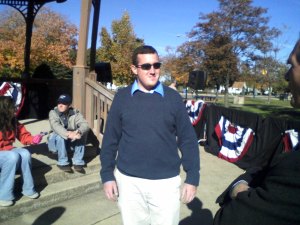
Matthew OldThis is a photo of Matthew Old, Erie County GOP Chair, taken in downtown Sandusky’s Washington Park on the day that John McCain and the Straight Talk Express made a Presidential campaign tour stop in Sandusky.

A few months later, at the Erie County Lincoln Day Dinner held last Friday, February 20th, Mr. Old remarked that local Republicans had been excited just to be able to host Senator McCain’s surrogates.  They were suprised when Senator McCain, the candidate himself, made plans to stop in Sandusky.

Are Ohio Republicans demoralized from the election losses in 2006 and 2008?  After seeing the turnout from Sandusky County, Seneca County, and Erie County at recent Lincoln Day Dinners, I’d be inclined to say that interest in participation in the party is on the INCREASE in early 2009.

2009 is an election “off-year,” when low profile local races such as city council, village council, township trustee, municipal court judge, and school board races are decided.  I’ve seen turnout for party functions in other “off-years.”  There may have been complacency on display during those other “off-years,” but this time is different.  What I’ve witnessed so far this year is hunger, and I’m not talking about hunger for food.

Tomorrow night, Tuesday, February 24th, I plan to be at the Cuyahoga County Lincoln Day Dinner, and I’ll be curious to see if the same trend manifests itself there.

At any rate, Matthew Old acknowledged that people in Erie County are seeking out the GOP in greater numbers.  One of the reasons I attended the function (held at the Sandusky Yacht Club, which, by the way, may very well have the most attentive and pampering waitstaff I’ve encountered anywhere) was that one of my mom’s friends, who lives in the city of Huron, was curious about getting involved in the Republican Party.  We thought that accompanying her to the Lincoln Day Dinner would help tremendously in introducing her to like-minded Republicans.  We weren’t disappointed.  In addition to the official Erie County GOP organization, there is also a club for Erie County Republican Women.  Apparently, my mom’s friend represented just the tip of the iceberg, because many new faces had emerged at recent party functions.

The keynote speaker for the evening was the chair of the Ohio Republican Party, Kevin DeWine.  He acknowledged that Republican officeholders in high places had made grave errors of hypocrisy leading to the election defeats of 2006 and 2008.  Our party platform includes principles of small government, balanced budgets, lower taxes, transparency, and ethics.  Yet, we witnessed the biggest expansion of government on the Republicans’ watch, with unbalanced Federal budgets, and closed-door deals that led to ethics scandals.  While Mr. DeWine acknowledged all of these errors, he said that the party must turn toward the future rather than wallow in the past.  I think everyone in attendance was there because we were concerned about the future, not because we were still focused on the past.

Regarding the future, Mr. DeWine said that we need to multiply our party’s membership rather than purge our party’s membership.  I’m inclined to agree.  After all, the name of this blog, Buckeye RINO, is partly a response to those who bandy the “RINO” appellation too freely.  Republicans are supposed to be the big tent party, not the groupthink party.  To be the big tent party, we have to be tolerant of varying opinions on a wide array of topics, though there are some bedrock principles that we all subscribe to.  The party of Lincoln is a party of liberty, not groupthink.

I think alarm over rampant socialism within our own nation is part of the motivation for the increased attendance at these functions.  Another common concern is the feeling that, when it comes to foreign affairs, we need to be every bit as relentless as our adversaries, and, frankly, it appears that our nation may be caving in on many international fronts.

Mr. DeWine said that he fully expected a solid GOP ticket for 9 statewide offices up for grabs in 2010.  While discussing some of the possible names that may appear on the 2010 ballot, he was careful to point out that only Rob Portman had made an official announcement so far.  Portman is seeking the U.S. Senate seat held by Senator George Voinovich, who has announced his retirement.

In one-on-one conversation with Mr. DeWine, I inquired about the ORP’s commitment to campaigning all over the state, not just in southwest Ohio.  Mr. DeWine gave his assurance that winning statewide races requires campaigning in northern Ohio.  What caused me to make such an inquiry?  It was the Secretary of State race in 2006, when Jim Trakas stepped aside to let Greg Hartmann carry the banner for the GOP.  Greg Hartmann was invisible in northern Ohio.  I don’t think we’ll see a repeat of that mistake in 2010.

Also in one-on-one conversation with Mr. DeWine, I asked about the GOP’s competitive disadvantage in early absentee voting.  Northern Ohio Republican candidates have fared much more poorly since absentee voting laws were changed to allow voters to vote early without having to specify a reason why they were choosing to do so.  Mr. DeWine said that many other states have made similar changes, so this is a topic of discussion that’s been brought before Michael Steele and the rest of the RNC.

Two other featured guests at the Erie County Lincoln Day Dinner on Friday night were two state senators:  Senator Karen Gillmor, and Senator Mark Wagoner.  Erie County is located within Senator Wagoner’s state senate district, so he was granted a few minutes to speak from the podium.  Senator Karen Gillmor didn’t speak from the podium, but she did work the room, meeting and greeting guests before dinner was served.

Kasich, Husted, Mandel, Latta, Gillmor, Wagner, Boose in Tiffin last night

Former Columbus-area Congressman John Kasich gave the keynote speech at the Seneca and Sandusky Counties’ Republican Party Lincoln Day Dinner last night (Feb. 5, 2009) in Tiffin.  I was in attendance to hear what he and others had to say.  You can check out this related article from the Tiffin Advertiser-Tribune, if you like.  Others who spoke from the podium included Dayton-area State Senator and former Ohio House Speaker Jon Husted, Cleveland-area State Representative Josh Mandel, and local Congressman Bob Latta.  Local State Senator Karen Gillmor and local State Representatives Jeff Wagner and Terry Boose were also in attendance, but did not speak.

As many in the blogosphere have already guessed, Kasich is giving serious thought to running for Ohio Governor in 2010, Jon Husted is giving serious thought to running for Ohio Secretary of State in 2010, and Josh Mandel is giving serious thought to running for Ohio Treasurer in 2010.  They confirmed from their own mouths that they were giving serious thought to running for these statewide positions, though none of them were ready to officially announce for certain that they were seeking these seats.

We’ve heard that Ohio has lost much more than 200,000 jobs since 2000.  Kasich is letting everyone know that Ohio has lost much more than 100,000 thousand jobs since Ted Strickland took office in early 2007.  Kasich is also letting everyone know that Ohio is dead last or nearly dead last among the fifty states for new business start-ups in virtually any way one chooses to measure such a statistic.  On the topics of both Ohio’s economy and Ohio’s education system, Kasich sees that under current leadership, Ohio is spiraling ever downward and out of control.  He likened the current national and statewide decay of our standard of living as what we’ve experienced during the Jimmy Carter Administration, with Democrats at the time telling us to lower our expectations for what the future had in store.  Ronald Reagan rejected the dismal forecasts and chose a bolder path.  John Kasich urged Republicans in attendance to reject the path of Obama, Reid, Pelosi, and Strickland.  He asked everyone to mobilize to turn Ohio around, starting with visiting the website www.RechargeOhio.com and signing up.

Husted echoed Kasich’s sentiments and reiterated some of Kasich’s statistics.

Mandel charmed the crowd with some self-deprecating humor about his youthful appearance, while reminding everyone of the dedicated women and men who serve in the armed forces.  He held up a pair of shoes with the soles and heels worn out from canvassing neighborhoods during his state rep campaigns, and promised he wouldn’t be outworked by his opponents if he officially undertakes the statewide campaign to become Ohio Treasurer.

Congressman Latta delivered the most red meat, as he hammered away at the foolishness of the bailout packages and the proposed economic stimulus bill.  Latta seemed quite genuine in his conservative assessment of the shenanigans on Capitol Hill, and the crowd reaction was very favorable.

Several local politicians were present, as well, with Seneca County Engineer Mark Zimmerman capturing much of the spotlight, since he emceed the event.

Petition time for municipal elections

While it seems that the last election is barely over, especially since Obama doesn’t take office until next week, it’s already prime time to circulate candidacy petitions for office if you’d like to run for municipal court judge or for partisan municipal elections this year.

Yes, there are elections in odd-numbered years.

In Ohio, in odd-numbered years, there may be elections for municipal court judges, city councils, village councils, mayors and other municipal executive branch offices, township clerks, township trustees, and school boards.

Of course, there aren’t usually announcements about petition filing deadlines.  By keeping quiet about such deadlines, political party insiders are often able to get their own hand-picked persons on the bottom rungs of the political ladder without much opposition.

I feel that some of my readers would make excellent public servants.  That’s why I’m giving you the heads-up.  If you want to run for municipal court judge, or you want to run for city council in a city that holds partisan elections (if there’s no city charter, then such would be the case), then the filing deadline for your petitions to run in the May 5th primary election is before 4 pm on February 19, 2009 at your county’s Board of Elections office.  For example, Lorain and Elyria are cities that hold partisan elections for city council (and there are many more such cities all over the state).  Some cities have city charters that specify that elections for city council are to be non-partisan.  City charters could specify the petition filing deadline date for such non-partisan races, so you’ve got some homework to do if that applies to your city.  Otherwise, candidates for township, school board, and non-partisan municipal races have until August 20 to file petitions for the November 3rd general election.

For those it applies to, February 19 is just around the corner.

It’s not required that you raise any money in order to run for office, but if you think you might want to raise campaign money, you need to fill out a Designation of Treasurer form with the county Board of Elections.  On the form, you will be asked to name your campaign committee.  You don’t have to organize boatloads of people to form a campaign committee.  Your committee could conceivably consist of just you, yourself.  Your surname should be included in the campaign committee name.  For example, if I were going to be a candidate, I might use “Williamson for City Council,” “Vote Williamson,”  “Friends of Daniel Williamson,” “Elect Williamson,” “Williamson Campaign Committee,” or some other phrase that included my surname of Williamson when naming the committee.  The form will ask you to specify which election race that you are a candidate for.  The form will ask you to include the contact information for your campaign committee.  The committee must have a PHYSICAL address, not just some P.O. Box.  Also, a treasurer must be named for your committee.  Your treasurer could be yourself.  If you wish, you could name a deputy treasurer in addition to a treasurer  (and the deputy treasurer could be yourself if someone else was named as treasurer).  If any campaign money is received or expended, the treasurer and/or deputy treasurer will be responsible for submitting the required financial reports.  None of the information  on this Designation of Treasurer form has to be permanently etched in stone.  If, after you file the form, you decide to change the office you seek election to, or decide to change the name of the committee, or decide to change the address of the committee, or change treasurers, just amend the information by filling out a new Designation of Treasurer form with the county Board of Elections.

If you do raise and expend campaign money, the campaign committee will need to have its own bank account.  Campaign funds cannot be commingled with any other funds.  Keep in mind, when shopping around for a bank account for the campaign committee, that you may need to submit copies of canceled checks (front and back) for your  committee expenditures to accompany your campaign finance reports.  You should receive printed instructions on campaign finance reporting requirements from the Board of Elections office when you submit your Designation of Treasurer form.  At the very least, make sure the BoE workers direct you to a source of information that will provide you with the most up-to-date rules concerning campaign finance reporting.  I’ve been my own campaign treasurer in the past, and I’m happy to say that preparing campaign finance reports isn’t rocket science, so please don’t feel intimidated.

Now, about the matter of circulating petitions.  You can get petition forms from the county Board of Elections.  Take a black ink pen and a clipboard with you when you gather signatures, so that you make it easy for people to sign without having to fumble around.  How many signatures you must gather depends on the election you are running for, and whether you are running as a candidate of a political party or not.  Do not collect more than 3 times the minimum number of signatures required.  Pay attention to the form.  The blanks at the beginning of the form must be filled in prior to collecting any signatures.  The blanks at the end of the form, where the petition circulator certifies and attests to collecting and witnessing all the signatures on the form, is to be filled out after collecting the signatures.  On any given form, there must be only one petition circulator, so if two or more people are circulating petitions for you, they must do so on separate forms, not ever on the same form.  Those who circulate petitions for you must be currently registered Ohio voters, and they must not be from a different political party than the candidate, if running in a partisan race, so don’t enlist the help of underage high school students to circulate petitions for you, since they wouldn’t be registered voters.

I recommend getting “walk lists” of the precincts that you’ll be running for election in, from the BoE.  The “walk lists” should show you the names of registered voters with their street addresses and party affiliations.  This way, you can make sure you are gathering VALID signatures.  You wouldn’t want the Board of Elections throwing out your petitions because signatures were found not to be valid.  Workers at the Board of Elections will be verifying that the signatures on your form match the signatures they have on file from the voter registration records.  They’ll verify that the name, signature, address, and party affiliation all match up between the petitions and the voter records.  That’s why I recommend walk lists.  You won’t see voter signatures on the walk lists, but you will be able to match up names, addresses, and party affiliations, since the walk list is generated from the voter records that the BoE has.

In partisan races, signatures won’t be valid if the voters who signed were from a different political party than the candidate.  Thus, Republican candidates cannot collect valid signatures from those identified as Democrats on voter rolls, but they can collect valid signatures from other Republicans and from independents.  For yet another example, Green Party candidates cannot collect valid signatures from those identified on voter rolls as Republicans or Democrats, but they can collect valid signatures from independents.  Those voters with no political party affiliation shown on the voter rolls are considered independent voters, and, as independents, they can sign on to any partisan petition without changing their independent status.  After all, party affiliation is determined by which political party ballot you choose to vote on during the primary elections.  Those who request “issues-only” ballots during primaries, and those who don’t vote at all in primaries are considered independents.  Those listed as Republicans must have voted in a Republican primary election in the past.  Those listed as Democrats must have voted in a Democrat primary election in the past.  That’s how those voters became affiliated with political parties on the voter rolls.

In the past, when I’ve inadvertently collected a signature that I believed wasn’t valid or thought might not be valid, I used my pen to draw a line through that entry on my form in order to cross it out before submitting the completed forms to the Board of Elections.  I did not include the crossed-off entries in my total tally of signatures that I certified and attested to when I filled in the blanks at the end of the form after finishing the signature collection but before the form submission to the Board of Elections.  Such precautions helped me to get an accurate count of valid signatures so that I knew my petitions wouldn’t be thrown out by the Board of Elections, and so that I wouldn’t have my petitions challenged by political opponents, either.

A disclaimer:  The recommendations I’ve made here are based on my past experience.  Laws may vary from locality to locality, and some laws may have been changed since I last ran for office in 2004, so please consult your county’s Board of Elections office for current laws applicable to you and your campaign in your location, or else consult the office of Ohio’s Secretary of State.

I really hope that voters have excellent candidates to choose from in this year’s township, village, city, school board, and municipal court races.  If you blog readers are among those who step forward to be candidates this year, I wish you the best of luck.

Ohio House Speaker Budish: “I’m for sale!”

He can’t help it.  Armond Budish is a Democrat politician from Cuyahoga County, after all.  If you don’t know what I mean by that, then you’ve probably never heard of the name of Jimmy Dimora, either.

The more things change, the more they stay the same.

Did you think that statehouse pay-to-play politics vanished because we switched from a Republican majority in the Ohio House of Representatives to a Democrat majority in the Ohio House of Representatives?  Did you think monumental changes are in store now that Democrats control legislation?  If you thought so, you haven’t been paying any attention to Buckeye RINO.  I’ve been saying all along that pay-to-play politics is a game that special interests play with BOTH political parties in the Ohio General Assembly.  I’ve been saying all along that you have to learn about the INDIVIDUAL you are voting for, and not just the party affiliation.

So, if you thought that ensconcing Armond Budish as the new Speaker of the House with Democrats in control would mark some kind of improvement over Householder/Husted/Dolan and a bunch of Republicans, you were WRONG.

This is the start of the biennium.  It’s the start of a new session of the General Assembly.   Do you know what that means?  Since it’s the point in time most distant from the time that one must stand for re-election,  that means now is the time to consider the most odious of legislation.  If there are issues that Ohioans oppose, but legislators favor, now is the time that legislators will act on those issues.

Why do legislators oppose the will of the people?  Because they get campaign contributions for doing so.  Now is the time to reward campaign donors, and now is the time to line up campaign donors for the next election run.  The legislators hope for two things:  First, that you won’t be paying any attention to the legislation that gets passed; and second, if you are paying attention, that you have a very short memory.

Perhaps the most publicized pay-to-play legislation at the beginning of the previous biennium was a Senate bill that hurt mom-and-pop cable television utilities in order to favor the big behemoths of the cable industry.  The spin of the politicians was that we’d see more competition within the cable TV industry, and our rates would go down.  Did anybody’s rates go down?  During the past year, my rate actually took a hike.  The Ohio General Assembly tried to feed us this hogwash because the cable TV behemoths, through their Political Action Committees, are able to be much more generous in donating to campaigns than the little mom-and-pop cable TV companies.

This biennium, the granddaddy of the pay-to-play PAC’s appear to be those connected to casino gambling.  Ohioans have repeatedly voted against casino ballot issues.  Ohioans don’t want casinos.  Our legislators do.  Our legislators always have.  Why?  Because if our legislators oppose gambling, they don’t receive PAC donations to their campaigns for sticking to their principles.  If our legislators support gambling, however, they stand to receive lots of campaign donations to gambling-related PAC’s.  With our legislators, money talks.  Ohioans talk, too, but our legislators turn a deaf ear when there’s no money attached.

Armond Budish (remember, he’s a Democrat politician from Cuyahoga County) was asked by the media about his thoughts on gambling.  The Plain Dealer quotes him thus:

“I have no inherent opposition to gambling by any means.”

He’s so emphatic, by adding the words “by any means” to the phrase “no inherent opposition.”  Doesn’t it sound like code for “I have no inner convictions,” or “I haven’t developed any scruples,” or, at the very least, “I might have some inner convictions/scruples, but why don’t you offer me some campaign money, and together we’ll explore just where those scruples might or might not be.”

How convenient.  At the get-go, politician Armond Budish is pointing out the lack of a personal conviction.  Just what we need more of–politicians without principles.  Yet, even if he, himself, lacked a personal conviction when it came to the gambling issue, isn’t he elected to represent Ohioans?  Since he leads the majority caucus in the Ohio House of Representatives, shouldn’t he feel a need to represent the majority of Ohioans?  And didn’t a majority of Ohioans vote down casino gambling every single time it was ever put before them as a ballot issue?  Yet, Budish did not acknowledge the demonstrated views of the majority of Ohioans in giving his position on gambling.  Instead, it was as if he was elected to a House district wherein he only represents himself, saying on the public record that he, himself, has no inherent opposition to gambling.  He’s not representing anybody but himself.  And by representing only himself, he’s advertising to all the PAC’s, even beyond the issue of gambling, that he’s all ears if you’ve got money to contribute.  Ohioans?  Bah, humbug!  Who are they, unless they can contribute $omething?

Hence, Armond Budish, Ohio’s Speaker of the House of Representatives, has announced to the world of lobbyists and donors, “I’M FOR SALE!!!!”

From the same Plain Dealer article, we see that Governor Strickland is advertising the fact that his spine is missing, as he’s caving in on pledges made to voters in 2006 that he opposes expansion of gambling.  He already introduced Keno to the Ohio Lottery.  Now he’s sounding the trumpet beckoning to all the casino tycoons.  If you want to read more on Strickland and gambling, check out Writes Like She Talks, with this article, this one, and also this one.

Before Strickland caved in on gambling, he was opposed.  Before he was opposed, he was wishy-washy, i.e. he was sending signals that he could be influenced, could be bought.  Again, Jill Miller Zimon posted at WLST about an interview that Strickland gave to an assembly of bloggers.  Back on March 27th, 2006, I had this to say about Strickland’s non-committal response:

” . . . As for Strickland and gambling, he has left the door open for pro-gambling PAC’s to donate to his campaign (I haven’t looked at any campaign finance reports yet to find out if this has indeed happened), and I certainly get the sense that he will let others do the dirty work to expand gambling here. He’s sending a signal that he can be ‘bought’ . . .”

Jill wanted me to elaborate on this point , so later, I added this:

” When a candidate makes a clear and definitive statement on an issue, then a candidate is clearly sending a message that they cannot be bought at an auction to the highest bidder. When a candidate makes a public statement on an issue that is totally ambiguous, that’s sending a message of ‘Go ahead and influence me! Make your checks out to . . .’”

And after Jill continued to press me on the point, I concluded with this:

“Someone who has known all sides of the issues for as long as Strickland has (How could he not? His whole career revolves around issues.) should have been able to draw some conclusions by now and found ways to effectively articulate for the positions he advocates. If he were merely a bystander, it would be easier to understand his indecisiveness. It almost makes me think that Strickland concedes that it’s a foregone conclusion that Ohioans support casinos. I doubt that Ohioans support casinos, since every ballot issue on the matter has gone down to defeat. The pro-gambling lobbyists have curried favor with our legislators, and that’s the arena where gambling really needs to be held in check.”

Was I clairvoyant, or what?  I’m telling you now, that I had Strickland pegged way back then.  So what I’m telling you about Budish . . . mark my words, he’s for sale.

[Update] Gov. Strickland, please help Lorain with its broken drawbridge

Lorain residents, and especially Lorain merchants, are getting a close-up look at the importance of transportation infrastructure in keeping the wheels of commerce greased.  In downtown Lorain, there is a drawbridge along U.S. Route 6 that crosses near the mouth of the Black River on the Lake Erie shore.  The name of the bridge is the Charles Berry Bascule Bridge.  The drawbridge doesn’t work.  It’s been stuck in the open position for months on end, creating detours for motorists and killing commerce along both banks of the river.  Not only is this an object lesson about the importance of infrastructure, it’s also an object lesson in red tape and the inefficiencies of state and county bureaucracies (in this case, the Ohio Department of Transportation is a prime example).  Ohio Governor Ted Strickland urged voters to support Tony Krasienko in Lorain’s mayoral race last year.  Guess what?  Krasienko won.  Now Krasienko needs Strickland’s support.  Now, Lorain needs Ohio’s executive branch to spring into action.

Governor Strickland, can you leverage some immediate relief for Lorain please?

Check out this pictorial from the Lorain County Photographer’s Blog to see the bridge with your own two eyeballs.  Then, from the same blog, hear the speeches of Lorain’s merchants and politicians while the residents gathered at the bridge to plea for assistance.

For the latest communication on the bridge matter, check out That Woman’s Weblog.  Things just aren’t happening.  Please, Governor Strickland, involve yourself in this matter long enough to get speedier results.

Of course, as noted before, I keep plugging for even more infrastructure.  The transportation grid upgrades I’ve proposed on the map below (the routes shown in red) would include at least one more bridge across the Black River, and it wouldn’t be a drawbridge.  It would also route traffic within a stone’s throw of the downtown at highway speeds of 65 m.p.h.

Lorain

More details on the mapped proposals are here, here, and here, at Word of Mouth.

[UPDATE] More pics and correspondence from Lorain County Photographer’s Blog.

The election results are in

Following up on the endorsement recap of yesterday, there were a few of the Buckeye RINO-endorsed candidates that won, but many of them lost.

Issue 6 went down to defeat, and I’m very happy about that.

The expected incumbent winners among those endorsed were Bob Latta of Ohio’s 5th Congressional District, and Jeff Wagner of Ohio House District 81.

There were newcomers elected, too.

Huron County elected Larry Silcox over Sharon Ward for an open commissioner seat.

Seneca County replaced long-time incumbent treasurer Marguerite Bernard with Damon Alt.

I never predicted who would win among those I endorsed . . . with one exception.  As soon as Matt Barrett stepped down from his seat in Ohio House District 58, I announced that the GOP would win the seat back from the Democrats.  I was correct.  Terry Boose emerges as the new state rep in the 58th District.

Though most of those I endorsed did not emerge victorious, I don’t regret making any of the endorsements that I made.  God bless you all, and God bless America.

Buckeye RINO endorsement recap

Today is the last day to get out and vote.  I urge all U.S. citizens to do so.

I’ve noted that traffic to the blog has been burrowing in to old posts to dig up what Buckeye RINO has said about the various campaign races currently underway.  I guess I should have made site navigation a little easier for the readers, so let me try to help out with this post and give you links to help you find what you are looking for.

U.S. President: I’m supporting John McCain.  Foreign policy is almost always the decisive factor for me when it comes to choosing the president, since Congress really doesn’t have a handle on the foreign policy agenda.  Congress DOES have a handle on the domestic policy agenda, which is why I give that less weight when making presidential voting decisions.  McCain’s foreign policy platform is the reason why, even though I opposed the bailout bill, I wasn’t lured to one of the minor party candidates who opposed the bailout.  If Joe Biden is sure that Obama will be tested by our enemies in the first 6 months if elected, you can be sure that the minor party candidates like Barr, Baldwin, and Nader would also be given that test.  McCain’s already been tested, and he passed the test.  I did write one entry about Obama and one of his foreign policy platform planks, but most of my writing about the McCain-Obama race was on the domestic front, much of it recorded in the 13-part HOPE ON series.  Here’s the link to HOPE ON Part 13, and there you’ll find links to the other twelve installments, and you’ll find those installments riddled with links, too.

Congress: I’ve endorsed Bob Latta in the 5th District, Bradley Leavitt in the 9th District, and Dave Potter in the 13th District.

Ohio’s ballot issues: I’m in favor of issues 1, 3, and 5, but I’m against issues 2 and 6.  I wrote an additional post about Issue 5, coupled with Issue 6.  I’ve also written extensively against issue 6, beginning with “Deep-six Issue 6,” and spelling out the economic downside of Issue 6, along with stances against Issue 6 from the viewpoints of Democrats, Libertarians, and Republicans.  I’ve linked to audio and video clips against Issue 6, I’ve urged voters to keep the zombies away and to frustrate lobbyists by voting no on 6, and I’ve expressed shocked surprise and disapproval when Issue 6 backers referred to the League of Women Voters as a “firing squad.”

General Assembly: Jeff Wagner in Ohio’s 81st House District.  I didn’t write about it, but in my own Ohio House District, the 80th, I voted for Ed Enderle for state rep.  When Matt Barrett’s problems came to light, I pointed to Terry Boose to pick up the baton for state rep in the 58th Ohio House District.  Heydinger was appointed to fill the rest of the Barrett term, but Heydinger decided to withdraw from the election because he felt the Ohio Democrat Party wanted to attach too many strings to him in exchange for financial campaign support.  Voters should think long and hard about that fact.  Terry Traster, a member of Amherst City Council that now is the Democrat standard-bearer, ideologically, doesn’t have a lot in common with the rest of the 58th District.  He’s not a good fit.  Lorain County Democrat politicians, like Traster, don’t often see eye-to-eye with the more rural and conservative voters of Huron County, southern Lorain County, and eastern Seneca County.  Terry Boose should be the pick of the 58th.

Seneca County: Damon Alt for Seneca County Treasurer.  Longtime incumbent Marguerite Bernard has to go.

Huron County: Larry Silcox for Huron County Commissioner.  Sharon Ward is not suitable.

Erie County: Mike Printy for Erie County Commissioner.

Cuyahoga County: Annette Butler for Cuyahoga County Prosecutor.

Lorain County: Nick Brusky and Martin O’Donnell for Lorain County Commissioner.  You can read more about the current state of affairs in Lorain County here, here, here, and here.

I voted last Monday

I voted during the early voting period last Monday, a week ago from today.

Should I thank Ohio Secretary of State Jennifer Brunner for an atmosphere simultaneously conducive to both vote fraud and vote suppression?  Or, was what I witnessed solely the creation of the Erie County Board of Elections?  Rumblings from various parts of the state suggest that the integrity of Ohio’s election systems are being questioned beyond just Erie County.

Check out this Cuyahoga County story about thousands of dead voters told by the television reporters at Cleveland’s Newsnet 5.

For even more news on the topic of election fraud, I recommend a visit to Vote Fraud Squad.  They have a clearinghouse of such stories at their site.

The potential for gaming the system to allow dead people to vote during early voting in Erie County definitely crossed my mind.  The early voting in Erie County took place in a room that adjoins the Board of Elections office.  There are two doors that lead into the voting room.  One door is leading to the voting room is from the main hallway.  The other door leading to the voting room is from the adjoining BoE office.  Both doors opened into the fairly narrow rectangular room on the room’s east end.  An oblong table was situated in the center of the room with a few table-top dividers to afford a limited amount of voting privacy for voters who were able to find a chair (crowded conditions meant that not everyone had a chance of finding a seat) where the dividers were.  There were other small spaces at that table top and at other very small tables on the perimeter of the room that afforded no privacy.  Chairs were at the tables and also along the perimeter, but conditions were crowded enough that a fire marshall might have questioned whether the number of persons in the room violated the fire code.  A voter enters the northeast door from the hallway, crosses the narrow side of the room to the southeast door from the BoE office where a small table obstructs the door.  Behind the table is one election worker (there’s only room for one to stand in the doorway) who hands voters an envelope with a form to fill out.  Beyond identifying which election is being voted on, the printed name of the voter, the address of the voter, and the date that the voter is casting their ballot, the form also requires a signature and a notation of either the driver’s license/state-issued ID number, or the last four digits of the social security number.  Voters look for some space in the narrow but long room to situate themselves so that they can fill out the form.  Once the form on the envelope is completed, they make their way back to the election worker in the southeast doorway and hand the envelope to her.  The worker hands the completed envelope to a co-worker in the BoE office who is out of the line of sight of the voter (with a worker standing in the doorway with a small table blocking the doorway, the view of the BoE office is rather obstructed).  The voter then waits for a few minutes while the out-of-sight BoE worker retrieves a ballot for the voter.  I’m assuming the BoE worker is matching the name, address, and signature with the voting records in order to make sure that a ballot for the correct precinct is selected.  The worker in the doorway calls out the name of the voter on the envelope when the ballot is ready to be picked up.  The voter now has the envelope and ballot in hand and again seeks out a space within the room to fill out the ballot.  Once the optical scan ballot is filled in, the voter folds it, stuffs it into the envelope, and then returns it to the worker.

OK, now that I’ve outlined the setting and the process for the early voting at the Erie County Board of Elections, let’s break it down into the components that can compromise the system.

  • By decree of Jennifer Brunner, no elections observers were permitted during early voting.
  • Instead of having a balance of paired Republican and Democrat poll workers like we are accustomed to seeing in voting precincts on election day, there was just one worker at the interface between the voter and the BoE.
  • Jennifer Brunner has already stated that checks of the social security numbers and driver’s license/state-issued ID numbers will not be completed because such a check could crash the system.  Brunner’s allegation sounds completely PHONEY (in other words, I think she’s LYING).
  • The worker at the BoE doesn’t check or even request to check any proof of identity or address when the voter approaches.  Everyone’s on the “honor” system.
  • The form on the envelope is filled out beyond the observation of the worker, including the affixing of the voter’s signature.  On election day at the polls, signatures are witnessed as they are affixed in  the voting rolls by the poll worders.  There is no witnessing of signatures during early voting.
  • Since no ID is presented to workers, and since Brunner won’t check the numbers used for ID purposes, the only verification the workers have to go on is the validity of the signature.  It may be hard to convincingly forge a signature in the presence of poll workers, but what about forging a signature beyond the eyesight of an election worker during early voting?  This is the kind of lapse that allows dead people to vote.
  • When one is filling out the ballot during early voting, it is not being done in the privacy of the voting booth.  People are standing around waiting for their name to be called to retrieve their ballot and envelope back, glancing over your shoulder while you fill in the bubbles on the optical scan sheet, and you know that it only takes a glance of a split second to see which bubble you’re filling in.  It can be intimidating when you vote in front of an audience.  Can such conditions influence the vote?  Can they suppress the vote?  Clearly the layout of the room and the procedures in place did not instill any sense of security and privacy while voting.
  • One more note on the voter suppression issue.  If overcrowding and long lines on election day are seen as attempts at vote suppression, then someone should be raising that same concern over early voting.
  • What about the envelope system and optical scan ballot system to begin with?  Doesn’t such a system lend itself to greater risk of ballot box stuffing than other forms of voting?  I pose these questions about optical scan ballots with my observations during a recount process in mind.

The early voting environment in my county doesn’t lend itself to confidence in the integrity of the system that Jennifer Brunner has provided us with.  No matter how the elections turn out, there will still be questions raised about how they were conducted.  My early voting experience in Erie County was, at the least, unsettling.

The Republican case against Issue 6

As I mentioned in the Democrat case against Issue 6, there are some Republican politicians pushing this ballot issue from the shadows.  Don’t be deceived by announcement that the Ohio Republican Party is officially against Issue 6.  There are a number of decent Republicans within the party, but there are those that have sold their soul as well.  Jill Miller Zimon of WLST outed one of the Republican backers: Jim Trakas.  There are others, I am sure, but they are engaged in a stealth campaign that, according to polls, seems to be working, as the poll numbers I’ve heard show 50% in favor of Issue 6, 41% against Issue 6, and 9% undecided.  The Ohio GOP is officially against Issue 6 largely due to the political clout of U.S. Senator George Voinovich (video link in this blog entry), who has never sold out or caved in on casino issues.

And why does a Republican who stands on a principle rather than takes bribes from a casino owner, like George Voinovich, oppose gambling?  There are many, many reasons, and Jill Miller Zimon, though a Democrat, has compiled many, many reasons that I’m sure Senator Voinovich would agree with.  Perhaps the best way to sum those reasons up is the adage that an ounce of prevention is worth a pound of cure.

An ounce of prevention is worth a pound of cure.

There are tremendous costs associated with gambling.

I’ve already written at length about the opportunity costs of gambling and how it contracts the economy as money is siphoned out of it.  The cure for the souring economy becomes so much more expensive when you’ve got leaks in it.

As JMZ noted in this post, gambling is destructive of self, family, and community.  The cure for self and family is expensive when one considers the lack of mental health parity among health insurance policies, never mind the fact that health coverage is blasted expensive even if there was parity.  The cure for family and community is expensive, as government often feels compelled to institute programs to combat the fallout.  That means tax dollars.  The tax dollar revenues from casinos in no way compensate for families that have been stripped of their resources by gambling and communities of declining property values where gambling has eaten up money that could have been used to keep up with rent, mortgage, utility payments or home improvements.  School districts, like Detroit’s, who get an influx of money from casinos don’t get enough to improve the academic achievements of students who come from homes broken by gambling.  More money isn’t fixing the worsening problem.

So for fiscal conservatives, prevention is key because the cure is unaffordable.

For social conservatives, the damage inflicted upon oneself, one’s family, and the rest of society by gambling away scarce resources is evident.  Unlike the libertarian viewpoint that, in advocating for maximization of individual liberty, only the damage to self is fully recognized, social conservatives are aware that gambling has more victims than just those who chose to gamble.  Curtailing gambling curtails the number of gambling’s victims, whether direct or indirect.  For many social conservatives, religious convictions might also play a role in deciding against gambling.

Then there is the issue of law and order.  Casinos are situated on the borderline between the black market and the above-ground economy.  Transparency may exist in other economic sectors and in government, but casinos are perpetually shrouded in shadow.  Casinos are the perfect venues for laundering money.  Law enforcement officials recognize they just don’t have the tools to unlock the secrets of the illegal activities that take place in casinos.  Intuitively, they may sense that money is being laundered, but there’s little they can do to penetrate the darkness.  The Fraternal Order of Police and other law enforcement organizations have routinely opposed casino ballot issues, and Issue 6 is not an exception to that rule.  As the push for transparency in government and commerce heightens, the demand for casinos increases, as criminals have fewer and fewer options for laundering their money out of plain sight.  If casinos were illegal everywhere, more criminal activity would be forced out into the open where it could be interdicted more effectively.  The above-ground economy would benefit, too, as the underground economy has less power to erode the above-ground economy.  Combined with greater transparency, a stable environment for economic growth accompanies law and order.

Finally, there is the recognition that casinos do not create wealth.  There is no production of goods or exchange of goods that occurs at a casino.  There is only a redistribution of wealth from the many gamblers to the few casino owners, with the gambler having received no value whatsoever for the money lost.

The Libertarian case against Issue 6

Libertarians, in general, feel that individual liberties should not be restricted unless they interfere with the liberties exercised by others.  Along that vein, Libertarians feel that those who choose to gamble ought to be able to do so without government stopping them from doing so.

However, Libertarians are not supporting Issue 6, which would grant a casino monopoly in Ohio.

Libertarians also feel that those who choose to own and operate casinos ought to be able to do so without government stopping them from doing so.  Issue 6 stops everyone from owning and operating a casino except for the MyOhioNow group.

I’ve touched on this in prior posts.  In my blog entry titled “Deep-six Issue 6,” I wrote:

“For those who are Libertarian who think that Ohio ought to allow casinos, let me assure you that Issue 6 is no Libertarian proposal.  If it were a Libertarian proposal, then we wouldn’t be talking about legalizing a casino monopoly within the state.  If it were a Libertarian proposal, it would simply be a blank check allowing anyone to open a casino in any community in the state without any barriers to competition, much like anyone can open a restaurant or a convenience store in any community in the state.  Issue 6 still makes it illegal for the ordinary person to open a casino.  Only one entity will be permitted to open a casino . . .”

In my blog entry titled “Video and audio against issue 6,” I included a link to an audio clip from WSPD radio featuring an interviewee from the Buckeye Institute, who shared some Libertarian arguments against Issue 6.

In my blog entry titled “Kalin Stipe at Word of Mouth presents the state ballot issues,” I included this quote from Kalin Stipe, who contributes to Word of Mouth blog:

“Why would we change our constitution to allow a monopoly when there are plenty of investors who would open up around Ohio. If you are going to change the law (especially the constitution) for one, then change it for all.

“The worst number of casinos to have in Ohio is ONE. Either keep it at zero or make it fair for more than one.”

Libertarians strongly believe in unfettered commerce and free enterprise.  The provisions of Issue 6 that bar any Ohio-based competition to the proposed casino violates fundamental principles of American free enterprise.  If MyOhioNow wants to build, own, and operate a casino, then you, or I, or the person down the street, or the person in the next county, or whoever, ought to also have the ability to build, own, and operate a casino.  That’s why Libertarians should oppose Issue 6.

The Democrat case against Issue 6

Believe me, there are highly placed Ohio Republicans who are backing Issue 6, the casino monopoly ballot issue.  They just haven’t made themselves visible.  In 2006, during the Ohio Learn and Earn Issue 3 campaign, the politicians who were doing the wheeling and dealing were front and center.  Ohioans got to see the sausage being made right before our eyes, and it made us sick.  We voted it down.  Issue 3 had more Democrat support, as casinos were planned for Democrat strongholds, and Democrat politicians were instrumental in earmarking the potential tax revenues for education.

Now some corrupt Republicans have put their proposal on the table, but they are trying as best they can to remain invisible.  They don’t want to allow the public to see the sausage while it’s being made.  If they’re invisible, then why do I say that the latest proposal is chiefly a Republican plan?  This casino monopoly is planned for the reddest, most Republican, sector of the state.  Some of the most outspoken Republican backers of gambling come from that part of the state, like state rep Blessing.  Furthermore, look at what’s proposed for the tax proceeds.  As part of Republican principles, we often say that government resources ought to be allocated more heavily at the local level, and less heavily at the state and federal levels.  But the pay-to-play General Assembly is so interested in getting re-elected that they are much more interested in legislation that puts dollars in their campaign war chests than they are about sticking to principles.  The pay-to-play state legislature has not funded the mandates they’ve placed upon counties, and has slashed revenue sharing with local governments in order to cover their own rear ends (i.e. balancing the state’s budget).  The proceeds from this casino monopoly are to be sent to the 88 counties to help cover up the fact that corrupt Republican legislators aren’t sticking to their principles about unfunded state mandates and empowering local governments to serve the people.  Of course, another reason for these corrupt Republicans to hide from public view is that gambling is contrary to conservative principles, whether it be redistribution of wealth (but from poor to rich, in this case), maintaining law and order, shrinking the economy, or the damage gambling causes to families and society.  By the way . . . the potshots I take against some prominent Republican state legislators should help readers understand why some have assigned me the moniker of RINO.

Readers may not trust me to elaborate on the Democrat case against Issue 6, since I’m a Republican, so let me defer to a hard-core Democrat blogger who has taken a whack at me from time to time.  Tim Russo of Blogger Interrupted schools Joseph, another Democrat who blogs at Plunderbund, about why good Democrats should oppose Issue 6.  Please pay attention.  This is important.  Here is part of his intro:

“Issue 6 is another example of the filthy rich attempting to buy a license to print their own money on the backs of the poorest Ohioans.  That’s what a casino is.  It’s not a business model, it’s not an industry, it is free money based on nothing but the desperation of poor people.”

When Joseph points out that the state’s economy sucks, and the casino backers want to invest millions in Clinton County, Tim Russo responds in this way:

“I want to tell these people that if they want to invest $600 million into Ohio, they can figure out a way to do so without being parasites on the poorest Ohioans.  Gambling is a regressive tax on the poor, and those dollars are nothing more than a down payment on making Ohioans even poorer.  Build a wind farm, dig for coal, make a high speed rail line, fund an internet startup.  If it’s really a $600 million investment in Ohio, then make it an investment, not a Dickensian regressive tax.”

When Joseph asks if voters should tell Clinton County residents who are losing their DHL jobs that they shouldn’t have casino jobs, Tim Russo replied:

“Yes, I want to be the one to tell those people, and their representatives in government, to find other options, and advocate for jobs that are not a Dickensian sentence to a parasitic existence relying on taking money from poor people.  These will not be good jobs.  They will not be stable jobs.  They will be low wage, low skill, low benefit, sweat shop scraps from the table of a developer who walks away with a fortune.”

When Joseph says we shouldn’t quibble over having to amend Ohio’s Constitution because it’s such a shoddy document in the first place, Tim Russo concedes the shoddy document part, but not the gambling part:

“The Ohio constitution is, in fact, a farce, which has become nothing more than an ATM for whoever has the most money to manipulate it for their own license to print money for themselves.  That does not mean I need to accept it.”

Speaking of farces, Joseph wrote this:

“Ohio’s voters have proven, year after year, they aren’t ready to approve a broader gambling bill that brings gaming to the whole state. This single-casino option seems like a pretty good compromise.”

And Tim Russo very sagely (are you paying attention?) wrote this:

The reason Ohio’s voters don’t want a broader gambling bill is that Ohio’s voters don’t want our state to become a giant black hole in which poor people are consumed by parasites for eternity, like the seventh circle of Dante’s inferno.  This isn’t Las Vegas, where there was nothing before gambling.  This is Ohio, where desperate people cling to nickels and dimes in their pockets after decades of decay.  A single casino is not a compromise, it is just the first step on the road to a state full of them.

I’ve added the bold type to emphasize what makes Joseph’s assertion so farcical to me.

Joseph said this casino could be used as a test case, and if the experiment doesn’t work, the experiment could be shut down.  I feel the need to interject my own opinion at this point to say that there’s no shutting down a casino once it starts.  The casino would be “grandfathered” in, and would be exempt from future bans on casinos, as we can’t write an ex post facto law that would retroactively ban the casino.  The casino backers would thank us for such a ban, protecting them from further competition, and gold-plating their monopoly status. Bad, bad, bad, bad, bad idea to treat this issue as a test case.  We already know what casinos do, anyway.

These are just excerpts, so follow the links if you want the whole enchilada.

I hope you were paying attention.