

Patrick Riley was appointed to be Lorain’s Law Director when Mark Provenza finally resigned.
Petition time looming for school board, township trustee, non-partisan municipal races
July 27, 2009 — buckeyerinoFed up with government? Do you feel you need to step in with common sense solutions? Well, there’s still time to do that, and get in at the ground level.
This year, there are township races, school board races, and municipal races.
Municipalities that have partisan races already have their ballots set for fall elections. If you missed that boat, you should have read my post last January about filing for those races.
But some municipalities have non-partisan races. Please keep in mind that if your municipality has a city charter, it’s likely that you have non-partisan races, but the city charter may list a petition-filing deadline for candidates that differs from deadlines that pertain to other types of candidates. Please check your city charter. Unless otherwise specified by city charter, local non-partisan candidate petition filing deadlines are before 4 pm on Thursday, August 20, 2009, at your county’s Board of Elections office.
School board and township races are non-partisan local races. Again, the deadline for filing petitions to be a candidate for these races is before 4 pm, Thursday, August 20, 2009, at your county’s Board of Elections office.
Perhaps my January post on the subject of launching candidacies might be helpful to you if you are contemplating a run for local office. Questions? You can try emailing me, if you like (see my “About” page), but you’re likely to get better answers from the Board of Elections office in your county, and you can always avail yourself of the Ohio Secretary of State webpage, and pose your questions to the SoS office.
At any rate, the deadline for declaring your candidacy for one of these non-partisan local races is right around the corner, so if you’ve been thinking about it, but haven’t taken action, NOW is the time to spring into action.
For Ohio’s sake, move county commissioner races
June 20, 2009 — buckeyerino“Along the rust belt that hugs Lake Erie’s shores, Democrats have long enjoyed a near monopoly on municipal and county governments.”
I began another Buckeye RINO post with those words, titled “Democrats control everything.”
If you are a Cuyahoga County voter, you probably think that’s a pretty cool thing that Democrats control everything. Nirvana has been achieved, right?
Oh. Except for the corruption. Funny thing, about that Cuyahoga County corruption . . . as I said before the last election, when I endorsed Annette Butler for Bill Mason’s County Prosecutor seat . . . “It has everything to do with the Democrat Party.”
Oh. Except for the economic woes of Ohio’s Rust Belt. But that has much to do with the corruption. Let Plain Dealer columnist Phillip Morris connect the dots for you, as he did in a column last Monday:
“When will we begin to aspire and agitate for honest and efficient government?
“When will we stop accepting the oversight of party hacks, interested more in preserving power and patronage than in advancing prosperity?
“When will we start to understand that our futures are being compromised by too many uninspired and uninspiring public officials who routinely exploit their offices for self-enrichment?
“When will we realize that we can never become a business incubator as long as we tolerate inefficient city and county government?
“When will we demand better for our children — and our industry — which continue to flee the area in droves?”
I know that everybody in Cleveland likes to blame George W. Bush for the tanking Rust Belt economy, but the former U.S. President has not been implicated in any of the corruption probes of Cuyahoga County officials. Let me just note that the “party hacks” referenced in the 2nd paragraph of that Phillip Morris column excerpt happen to be Democrat party hacks, since the Democrats are the ones who control all the legislative and executive branch offices of Cuyahoga County government.
Talk of a Cuyahoga County government reform package by way of home rule charter has died down.
Phillip Morris asks for voters to start pressuring Dennis Kucinich, Marcia Fudge, and Frank Jackson to present a new plan to reform the county. I think that’s looking to the wrong direction for reform.
The right direction for reforming county government is for voters looking in the mirror and putting pressure on themselves to learn more about election candidates than whether they are Democrat or not. They have to start voting for the person, and stop voting for the party. Jimmy Dimora does not fear any wrath from Cuyahoga County voters. He knows that they will always vote Democrat. Even if Dimora has to step down, he knows that he can always get a crony to replace him, since Democrats will surely always win. Unless Cuyahoga County voters demonstrate that they are capable of voting for a Republican instead of rubberstamping even the most corrupt of Democrats, reform will continue to be elusive.
How is it that even the most corrupt Democrats win county elections time after time after time? I think it’s mostly that they hide in the coattails of the top of the ticket. In presidential and gubernatorial years, the ODP looks to maximize voter turnout in Cuyahoga County to help the top of the ticket carry the state. A lot of the voters that come out of the woodwork for those elections only know about the presidential or gubernatorial candidates at the top of the ticket, but they vote in all the races, using the Democrat party affiliation as their guide in the races they know nothing about. It happens in more than just Cuyahoga County (an example from Lorain County here), and that’s how voters enable entrenched cronyism and corruption. The counties with the least government corruption are those with swing voters, where politicians fear that if they screw up, they’ll be voted out in very short order.
I do have a proposal, though, for cleaning up county governments, not just in the rust belt, but throughout Ohio, and it doesn’t require any home rule charters be implemented for restructuring governments:
Just move the election dates. Elect county commissioners in odd-numbered years.
If we are going to look to a Cleveland-area Democrat elected official to put pressure on to reform county government, let’s not start with Kucinich, Fudge, and Jackson, as Phillip Morris suggests. Let’s start with Ohio House Speaker Armond “I’m for sale!” Budish. Let’s see if Budish is willing to distance himself from the Dimoras, and Russos, et al, of Cuyahoga County. Let’s get action from the Ohio General Assembly to begin the process to amend our state constitution, to change the law, whatever it takes, to move the elections for county commissioners throughout Ohio to odd-numbered years.
Odd-numbered years, like this one, are low turnout years, because we vote for obscure offices like city government, village government, school boards, and township trustees. We ought to encourage more turnout for these local offices. We can do so by bringing a higher profile race to odd-numbered election years. So let’s hold elections for county commissioners in odd-numbered years.
County Commissioners wouldn’t be able to hide in the coattails of the top of the ticket. Instead, they’d be the top of the ticket. They wouldn’t be able to hide. They’d have to withstand more scrutiny. If Cuyahoga County commissioner candidates want to turn out Democrats who will vote straight tickets, they, themselves, will have to be the draw, not the presidential or the gubernatorial candidates.
We’ll make it easier for county commissioners all over Ohio to fear the wrath of voters.
How would we make the transition? In 2010, we elect commissioners to a three-year term. They’d be up for re-election to a four-year term starting in 2013. Likewise, in 2012, we elect commissioners to a three-year term, and they’d be up for re-election to a four-year term in 2015. That would complete the transition.
More than just Cuyahoga County would benefit from this change. 86 other counties (Summit County has home rule charter) would benefit as well. This is a county government reform measure that can be put into place that Jimmy Dimora can’t block from being enacted, as the State of Ohio will be the entity that undertakes the reform, not Cuyahoga County.
Supplemental learning opportunities: School Enterprise Zones
June 2, 2009 — buckeyerinoIn my recent post expressing my opposition to charter schools, I had this to say about my own education in the public schools:
My parents are aware that sometimes values are taught in public school that run counter to their own values. My parents are aware that some values are totally missing from the public schools. Knowing such things, but also knowing that they bore the ultimate responsibility for our education, they supplemented my public school learning with other opportunities for learning.
Parents can (and ought) to supplement their children’s education in order to customize and tailor the learning experience to fit their children’s unique personalities, and align that education with a parent’s values and priorities. This follows from the assertion that parents (not the schools, not the government) are the ones who are ultimately responsible for a child’s education. The government provides schools, but parents should view them as merely a tool to help them fulfill their own responsibility for seeing that their children are educated. Parents should not feel tempted (yet they often are) to abdicate their responsibilities to educate their children and lay that burden, instead, upon the school.
Furthermore, for families who like charter schools because they have champagne taste and want a private school experience for their children, but they are only willing or able to set aside a beer budget to obtain it (with unvoted, confiscated tax dollars used as subsidies), supplemental learning opportunities make it possible to make the public school experience more like a private school experience without breaking the bank.
My own parents had limited time and limited funds, and they had 10 children. That’s the main reason they opted for public schools. However, public schools were only one item on the learning menu that they selected for us. How much nutrition can you get if your meal only consists of one dish? How much easier is it to optimize your nutrition if the main entree is a smaller portion of the meal and side dishes are added? So, think of public school as an entree that delivers on a few of the educational nutrition needs, but think about the learning activities that should be offered as side dishes to add nutrients that the entree is missing. If, after doing all this, your parental priorities and values aren’t reflected in what appears on your children’s educational dinner plate, don’t blame the schools. Go look in the mirror. Blame the person you see reflected in the mirror.
When I was in high school, I was involved in some extra-curricular activities, such as the cross-country team, the track team, the school play, the school choir, and a number of student clubs. I also had a lot of responsibility at home, as the oldest of the 10 kids that my parents had, and those household responsibilities were learning opportunities. Our family attended church together on Sundays. I had occasional access to the YMCA. I had ready access to the local library. My parents had an excellent selection of reference books at home. Our family had a very large yard for outdoor activities. I met each school-day morning, before school started, for Bible study with other students who attended both my school and my church. I also participated in 4-H and Boy Scouts. When I was younger, I had piano lessons (I discontinued the lessons by my own choice–I was never any good at piano, but it did teach me how to read music, so it wasn’t a total waste) and swimming lessons. As you can see, school was just an entree. There were many side dishes.
I am mindful that supplementing a child’s learning might be inconvenient. It’s hard to think of oneself as a parent when one is relegated to the role of taxi driver, shuttling this kid here for this activity by this time, and that kid there for that activity by that time, and then picking them up afterward. Wouldn’t it be so much better if a wide array of supplemental learning opportunities were available in one location? Wouldn’t it be better yet if that location were adjacent to the school? A parent wouldn’t have to feel like a lowly taxi driver for their children, if such were the case.
I propose that we add another facet to regional and urban planning. I call it the “School Enterprise Zone.” This is a concept I’ve been publicly touting since the days of my first state rep campaign back in 2002. When I was a contributor to Word of Mouth blog, before the launch of Buckeye RINO, I wrote a three-part piece about the concept, which you can find here, here, and here. It’s a land-use designation that Ohio communities could add to their options when they contemplate zoning ordinances. What it’s designed to do is make it easier for properties adjacent to schools to transition from residential/commercial/industrial property to property where supplemental learning opportunities are available for children. The key mechanisms to make it work are removing impediments to entrepreneurial providers of supplemental learning opportunities.
Let’s say I’m a martial arts instructor, or a piano teacher, or a youth minister of a church, or a fencing instructor, or an arts and crafts workshop leader, or a ballet teacher, or a Brownie Scout leader, or . . . somebody that has some programs designed to involve kids, and I buy a house within a School Enterprise Zone that surrounds the school. Let’s face it, I’m not going to become fabulously rich by offering after-school lessons to kids. I just want to at least scrape by, or at least supplement some other household income with teaching or coaching or mentoring kids on the side, or maybe I’m just a volunteer, like the Brownie Scout leader, and I don’t want a lot of government-imposed red tape, regulations, and fees to get in the way of providing programs for kids. A School Enterprise Zone could make the task less daunting.
Here are some examples of what a School Enterprise Zone designation could facilitate:
Example 1: Schools are often located in residential zones. Often, residentially zoned properties are prohibited from being sites of commercial activity. The School Enterprise Zone would relax those restrictions to allow commercial activities that provide programming for kids.
Example 2: Ohio laws don’t allow certain adult-oriented businesses, such as bars, within a certain distance of a school. Also, registered sex offenders are required to reside beyond a certain distance of a school. By creating a School Enterprise Zone, the boundaries of the “safety envelope” would be expanded.
Example 3: In converting a house within a School Enterprise Zone from strictly residential to a house where some of the space is reserved for private living space and some of the space is used for commercial activity related to programming for children, only a portion of the public space would be required to be handicap-accessible, not the entire facility, thus negating the need for expensive remodeling projects.
Example 4: Tax exemptions could be offered to qualifying entities within the School Enterprise Zone to help keep overhead expenses low so that these enterprises can keep afloat.
Example 5: Instead of parents being an after school taxi service, they may send a note to school signaling that their child is to be released to an agent of the after-school program when school is dismissed for the day. The parents then don’t have to pick up, drop off, and pick up again. They just have to pick up.
Example 6: If the School Board allows it, some of the school facilities may be rented out to after-school program providers. A ballet instructor may require more performance space than a residential setting may allow, and converting enough space for performance space on private property may be too costly. Instead, the instructor’s property within the school enterprise zone may contain just the business office for the ballet instructor while she rents performance space at the school.
Example 7: If school district budget cuts cause them to no longer offer some extracurricular activities, it may create an opportunity for a new program offering within the School Enterprise Zone. For example, if the junior high no longer has a football team, perhaps an enterprising would-be football coach would set up office in the coach’s home within the School Enterprise Zone and rent the school’s athletic field so that kids can continue to play football.
Example 8: Parents and kids could buy the supplies and equipment they need directly from the after-school program within the School Enterprise Zone instead of having to make a trip to the mall. I propose that such purchases within the School Enterprise Zone be made exempt from sales tax to make the after school activities less expensive for parents. But even without a tax exemption, there is added convenience when one can buy what supplies are needed on-site rather than having to taxi kids to far-flung shopping centers to procure the supplies.
Parents, of course, would foot the bill for whatever after-school programs they enroll their children in, and since funds may not be able to stretch far and since chidren are a precious commodity, the motivation behind creating School Enterprise Zones would be to conveniently locate an array of low-cost, low-risk supplemental learning opportunities.
Where is Sandusky’s City Manager?
May 21, 2009 — buckeyerinoIf you happened to read my post titled “Smackdown on women in Sandusky,” then you are fully prepared to appreciate the humor behind this video from the Sandusky Register website. What’s not good for the goose seems to be good for the gander. Have a gander.
(ROFL!)
A new day in Lorain with a new law director
May 5, 2009 — buckeyerinoIt’s been a long time coming, hasn’t it?
If you’ve been a regular reader here at Buckeye RINO, then you know I’ve been clamoring for Mark Provenza, serial drunk driver, to step down as law director in the city of Lorain.
Provenza eventually did step down, and now, finally, a new appointee, Patrick Riley, has officially been sworn in as the new Law Director. Lorain’s Morning Journal had some nice things to report about Riley’s first day on the job:
“The lawyers in the department have all been given set schedules and assigned specific city departments for which they are responsible. He [Riley] also put in a system that will track legal opinion requests and ensure they are responded to within five business days and developed a filing system for all the city’s litigation . . .”
Riley also hopes to do more with less by seeking law students to assist his staff as volunteers, thereby having more hands on deck for the same amount of payroll, and the law students receive valuable experience for their resumes before they graduate into a tough labor market. Sounds smart to me. Couldn’t Provenza have thought of such a thing?
Perhaps with a new ethic in how the work in the law director’s office is proceeding, a city employee handbook defining the code of conduct that city employees should adhere to might have a chance of being formulated and implemented.
But then, maybe I should be more cautious about expressing glimmers of optimism.
Glenn Beck: “You are not alone”
March 17, 2009 — buckeyerinoI remember when Glenn Beck was a virtual nobody on the radio, and he didn’t always seem to have a message that was in focus. As time has passed, it seems that he’s really finding his voice, and there’s much more consistency in his views of the issues. If any program on the cable news networks sounded a cautionary note far in advance of the bursting of our nation’s housing bubble, it was Glenn Beck during his 7 pm and 9 pm time slots on CNN’s Headline News. I noticed that more and more people who I encountered in daily life were identifying themselves as Glenn Beck fans.
Then there was an announcement that Glenn Beck had reached an agreement with Fox News Channel that he’d be airing a program weeknights at 5 pm. Immediately, Glenn Beck disappeared from Headline News. There was a lull among Glenn Beck fans, with no TV show to watch, and with the radio broadcasts difficult to locate on radio dials (and perhaps at a time of day when one isn’t available to listen in) but it was a lull with baited breath, as Glenn Beck fans counted down the days anticipating Glenn Beck’s return to television.
I thought that a 5 pm air time would knock some wind out of Glenn Beck’s sails, since he no longer had air times that were considered prime time. That doesn’t seem to be the case. If anything, the audience interest is intensifying, and I’ve encountered even a greater percentage of people that I bump into are taking notice of Glenn Beck.
A case in point: Last Friday, I watched Glenn Beck’s show on Fox News. But I didn’t watch it at my house. Instead, I watched it amidst a small gathering of people who’d assembled together for the express purpose of watching Glenn Beck together. I wasn’t the ringleader behind the effort to gather for a Glenn Beck program, either. Usually, I’m the one who’s dragging others to political events, not the other way around. This time, others invited me, . . . and my dad, and my mom, and my brother, too. Others were taking the initiative.
Is it just my imagination? Or is Glenn Beck really motivating people at the grassroots to engage each other in discourse about our communities, our states, and our nation? OK, maybe the numbers are still small . . . maybe I’m making a mountain out of a molehill, but there’s one thing I did get a sense of while watching Glenn Beck: I’m not alone. For Glenn Beck, that was a primary purpose behind the desire for people to view Friday’s program at gatherings rather than staying home to watch. His message of “You are not alone” was designed to demonstrate that I’m not the only person up in arms over the erosion of the maxim that government in our nation is “OF the people, BY the people, and FOR the people.” I sometimes wonder at the loneliness of my soap box perch at Buckeye RINO, with its modest traffic count of perhaps one page view per month, wondering if my disdain for bailouts and for socialist takeovers registers with anyone. Well, others may not be reading Buckeye RINO, but I did find myself gathered among like-minded individuals who share my concern that the people need to reassert their sovereignty over the government . . . thanks to Glenn Beck.
Besides assuring me that I’m not alone, there were a couple of other things Glenn Beck wanted to achieve. One of those was to remember the way we all felt on September 12, 2001. To that end, Glenn Beck invited all to check out a website titled THE912PROJECT.COM. I don’t want to have to explain what it is, so just click on the link and see. OK?
One other thing that we could achieve by gathering was to make plans for what we, individually and collectively, could do along a civic vein in the spirit of September 12th. After watching Glenn Beck, our gathering took a short break, drove over to a local restaurant, and reconvened for supper where we discussed being involved in local campaigns and local politics. I thought I would be the one most eager to get revved up for local political advocacy, but not so. Others seemed quite eager to take the bull by the horns.
One more thought: For those who think this recent smattering of “Tea Parties” in various cities around the country are just a hiccup, that’s not the vibe I’m picking up. I think it’s the tip of the iceberg. I think there is more fervor among the right-of-center grassroots now than there was a year ago, and the fervor seems to be growing, not waning.
Smackdown on women in Sandusky
March 10, 2009 — buckeyerinoOkay, let’s start with a basic fact: I’m male.
Therefore, when it comes to sexism, more specifically, misogyny, I am not always able to perceive subtleties. For example, when Jill Miller Zimon, of Writes Like She Talks, complained how a photograph of Hillary Rodham Clinton was used on a magazine cover, I just didn’t get it. I think Scott Piepho correctly assessed the situation at Pho’s Norka Pages. If I was perplexed about what JMZ was driving at, when referring to Hillary Rodham Clinton, I was further perplexed at what was in-bounds and what was in foul territory after JMZ ridiculed Sarah Palin mercilessly in the run-up to the November elections.
But here’s one more basic fact to consider: I was born in Sandusky, Ohio.
In Sandusky, Ohio, one doesn’t have to sift through nuance and subltety to find instances of sexism. No. In Sandusky, the Good Old Boys’ tastes in misogyny trend more toward sexism that’s blatant and overt. Perhaps that’s why I couldn’t discern the nuances that JMZ expounded upon, because I was raised in an environment of stark contrasts.
Rove (and Mandel) and the RPCC (and Mandel)
February 25, 2009 — buckeyerinoOn Tuesday, February 24th, the Republican Party of Cuyahoga County held their Lincoln Day Dinner in downtown Cleveland in the Grand Ballroom of the Renaissance Hotel. The featured speaker was Karl Rove.
The cost of an individual ticket to the dinner was $85. In the hinterlands of Ohio, I’m accustomed to a Lincoln Day Dinner price tag of $25. If it were $25 in Cuyahoga County, though, I imagine 3 or 4 thousand people would show up for dinner. What facility is large enough to seat 3 or 4 thousand people for dinner all at the same time and serve them all a formal dinner? The Grand Ballroom at the Renaissance Hotel was as big a venue as I’ve seen for such occasions, and it was packed. I’m guessing there were 800 guests, since there were about 80 tables, with 10 persons to a table.
In one sense, Cuyahoga County Republicans may seem a bit dysfunctional. After all, the Democrats have a virtual lock on elected offices throughout the county and especially in Cleveland. Furthermore, the Republican base in southwest Ohio may be of the opinion that at least half of all Cleveland-area Republicans are RINO’s. But, RPCC chair Robert Frost and featured speaker Karl Rove both underscored the importance of turning out the Republican vote in Cuyahoga County. Which Ohio county gave more votes to John McCain for president than any other Ohio county last November? Cuyahoga County did.
So, if you are looking to win a statewide office, and you forecast that you need a specific number of votes to win a statewide majority, where are you going to look for votes first? Podunkville? Heck, no! You’re going to get as many votes out of Cuyahoga County that you can get your hands on. From my conversation with Kevin DeWine in Sandusky last Friday, I’d say that the ORP would agree with that assessment.
Having said that, not all statewide hopefuls were in attendance in Cleveland on Tuesday night. I hope they were doing something very meaningful, like attending a family member’s ballet recital, because if they were doing something of a political nature, and they weren’t in Cleveland, they weren’t being as productive as they could have been.
So who was there? State Auditor Mary Taylor was there. She led the Pledge of Allegiance. Supreme Court Justice Terrence O’Donnell was there. He gave a lengthy invocation after saying numerous words about Abraham Lincoln (I greatly appreciate Reverend Clyde Davis, who proceeded directly to the benediction prayer without speechifying, rather than following the example of Justice O’Donnell). Jim Petro was there. Sandy O’Brien was there. State Rep Nan Baker was there, as well as a number of suburban mayors and council members.
Most of all, Josh Mandel was there. State Rep Josh Mandel shared much the same message that he had when he appeared in Tiffin earlier this month. But it didn’t end there. Mr. Frost said a lot of nice things about Mr. Mandel. But it didn’t end there, either. Karl Rove, the keynote speaker, had some very nice things to say about Mr. Mandel, too.
They said Rob Portman had been in Cleveland to speak last year. The U.S. Senator-wannabe had postcards distributed to every seat at every table. Speakers urged us to fill out the form on the Portman postcards and send them in. It seemed empty, though, because Portman wasn’t there. He was a ghost, a shadow of the past. He wasn’t larger than life. Josh Mandel was there, and he was larger than life.
John Kasich was probably busy parsing President Obama’s speech so that he could appear as a pundit on Fox News with savvy commentary about the stimulus bill. I get the sense that a lot of Cleveland Republicans are too busy in the evenings to tune in to television, let alone Fox News. For whatever reason, John Kasich, who wants to be Ohio’s next governor, wasn’t there. Unlike Rob Portman, Kasich wasn’t even a ghost, wasn’t even a shadow, wasn’t even a whisper, because he didn’t even have anyone plugging his candidacy and there was no Kasich literature. Kasich wasn’t there, so he had no chance to be larger than life. Josh Mandel was there, and he was larger than life.
Karl Rove’s most stirring moments occurred while he described the service of those in the nation’s armed forces. He also talked about what it takes to keep the country safe. He talked about the economic crisis, even pointed a finger at the person who stood in the way of Fannie Mae/Freddie Mac reforms that would have prevented the housing bubble in the first place (the U.S. Senator from Connecticut, Christopher Dodd). Of course, he also talked about George W. Bush. And Josh Mandel.
Seneca County Treasurers
February 24, 2009 — buckeyerinoI’ve noticed a lot of digging through some prior posts at Buckeye RINO related to last fall’s election contest between Seneca County Treasurer Marguerite Bernard and challenger Damon Alt.
Perhaps those of you who are digging through are puzzled about having Marguerite Bernard’s name on your property tax bills when you thought for sure that you had elected Damon Alt. If so, let me assure you that Damon Alt did indeed win the election in November, and is the Seneca County Treasurer-Elect. Damon Alt’s term in office is scheduled to start at the beginning of September, so we will be getting the treasurer that was elected, but Bernard is still the treasurer at this moment. I hope this clears up some questions.
Erie County Republicans meet Kevin DeWine
February 23, 2009 — buckeyerino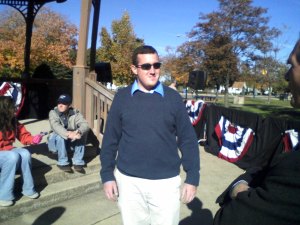 This is a photo of Matthew Old, Erie County GOP Chair, taken in downtown Sandusky’s Washington Park on the day that John McCain and the Straight Talk Express made a Presidential campaign tour stop in Sandusky.
A few months later, at the Erie County Lincoln Day Dinner held last Friday, February 20th, Mr. Old remarked that local Republicans had been excited just to be able to host Senator McCain’s surrogates. They were suprised when Senator McCain, the candidate himself, made plans to stop in Sandusky.
Are Ohio Republicans demoralized from the election losses in 2006 and 2008? After seeing the turnout from Sandusky County, Seneca County, and Erie County at recent Lincoln Day Dinners, I’d be inclined to say that interest in participation in the party is on the INCREASE in early 2009.
2009 is an election “off-year,” when low profile local races such as city council, village council, township trustee, municipal court judge, and school board races are decided. I’ve seen turnout for party functions in other “off-years.” There may have been complacency on display during those other “off-years,” but this time is different. What I’ve witnessed so far this year is hunger, and I’m not talking about hunger for food.
Tomorrow night, Tuesday, February 24th, I plan to be at the Cuyahoga County Lincoln Day Dinner, and I’ll be curious to see if the same trend manifests itself there.
At any rate, Matthew Old acknowledged that people in Erie County are seeking out the GOP in greater numbers. One of the reasons I attended the function (held at the Sandusky Yacht Club, which, by the way, may very well have the most attentive and pampering waitstaff I’ve encountered anywhere) was that one of my mom’s friends, who lives in the city of Huron, was curious about getting involved in the Republican Party. We thought that accompanying her to the Lincoln Day Dinner would help tremendously in introducing her to like-minded Republicans. We weren’t disappointed. In addition to the official Erie County GOP organization, there is also a club for Erie County Republican Women. Apparently, my mom’s friend represented just the tip of the iceberg, because many new faces had emerged at recent party functions.
The keynote speaker for the evening was the chair of the Ohio Republican Party, Kevin DeWine. He acknowledged that Republican officeholders in high places had made grave errors of hypocrisy leading to the election defeats of 2006 and 2008. Our party platform includes principles of small government, balanced budgets, lower taxes, transparency, and ethics. Yet, we witnessed the biggest expansion of government on the Republicans’ watch, with unbalanced Federal budgets, and closed-door deals that led to ethics scandals. While Mr. DeWine acknowledged all of these errors, he said that the party must turn toward the future rather than wallow in the past. I think everyone in attendance was there because we were concerned about the future, not because we were still focused on the past.
Regarding the future, Mr. DeWine said that we need to multiply our party’s membership rather than purge our party’s membership. I’m inclined to agree. After all, the name of this blog, Buckeye RINO, is partly a response to those who bandy the “RINO” appellation too freely. Republicans are supposed to be the big tent party, not the groupthink party. To be the big tent party, we have to be tolerant of varying opinions on a wide array of topics, though there are some bedrock principles that we all subscribe to. The party of Lincoln is a party of liberty, not groupthink.
I think alarm over rampant socialism within our own nation is part of the motivation for the increased attendance at these functions. Another common concern is the feeling that, when it comes to foreign affairs, we need to be every bit as relentless as our adversaries, and, frankly, it appears that our nation may be caving in on many international fronts.
Mr. DeWine said that he fully expected a solid GOP ticket for 9 statewide offices up for grabs in 2010. While discussing some of the possible names that may appear on the 2010 ballot, he was careful to point out that only Rob Portman had made an official announcement so far. Portman is seeking the U.S. Senate seat held by Senator George Voinovich, who has announced his retirement.
In one-on-one conversation with Mr. DeWine, I inquired about the ORP’s commitment to campaigning all over the state, not just in southwest Ohio. Mr. DeWine gave his assurance that winning statewide races requires campaigning in northern Ohio. What caused me to make such an inquiry? It was the Secretary of State race in 2006, when Jim Trakas stepped aside to let Greg Hartmann carry the banner for the GOP. Greg Hartmann was invisible in northern Ohio. I don’t think we’ll see a repeat of that mistake in 2010.
Also in one-on-one conversation with Mr. DeWine, I asked about the GOP’s competitive disadvantage in early absentee voting. Northern Ohio Republican candidates have fared much more poorly since absentee voting laws were changed to allow voters to vote early without having to specify a reason why they were choosing to do so. Mr. DeWine said that many other states have made similar changes, so this is a topic of discussion that’s been brought before Michael Steele and the rest of the RNC.
Two other featured guests at the Erie County Lincoln Day Dinner on Friday night were two state senators: Senator Karen Gillmor, and Senator Mark Wagoner. Erie County is located within Senator Wagoner’s state senate district, so he was granted a few minutes to speak from the podium. Senator Karen Gillmor didn’t speak from the podium, but she did work the room, meeting and greeting guests before dinner was served.
Have you received your property tax bill for 2009?
February 6, 2009 — buckeyerinoI’ve heard complaints from homeowners in both Erie County and Lorain County that tax appraisal valuations have kept increasing recently even though the bottom has been falling out of the northern Ohio housing market since 2000.
I think it’s worth noting that County Auditors will be up for election in 2010, and it’s not too early for challengers to launch campaigns and start raising money. Just fill out a Designation of Treasurer form for your campaign committee and submit it to the Board of Elections, as I’ve written about in this blog entry, and you’ll have the greenlight to start raising campaign funds. You won’t have to worry about circulating petitions until the beginning of next year. In my opinion, both Erie County Auditor Tom Paul and Lorain County Auditor Mark Stewart are tyrants that ought to be replaced by voters.
I understand that the property valuation should be a rolling average of at least the past three years, so perhaps there might be a little bit of a lag between what the market value drops to and what the tax valuation drops to, but I’m hearing complaints that tax valuations in the two counties keep creeping UP, not down. I’ve seen tax valuations for properties that are higher than the selling price ever was and higher than the marketplace could ever sustain. Such practices amount to nothing short of a money grab by county government, specifically, the County Auditors’ offices. Some politicians don’t respect the citizens enough to put tax increase proposals on the ballot, and some even ignore the citizens after they have voted down tax increases, and they use these ever-upward-creeping assessed property values to artificially inflate tax revenues. Meanwhile, it’s no secret that REAL market values for homes have been plummeting for eight or nine years now, and assessed values should have been dropping downward to reflect that dynamic.
So what should you do beyond vote out these tax-grabbing county auditors?
That Woman’s Weblog has an excellent article on this very topic. It is possible for you to request an appeal of your home’s tax appraisal valuation. Please check it out and follow up. Don’t let yourself be a victim of artificially inflated tax appraisal valuations.
Kasich, Husted, Mandel, Latta, Gillmor, Wagner, Boose in Tiffin last night
February 6, 2009 — buckeyerinoFormer Columbus-area Congressman John Kasich gave the keynote speech at the Seneca and Sandusky Counties’ Republican Party Lincoln Day Dinner last night (Feb. 5, 2009) in Tiffin. I was in attendance to hear what he and others had to say. You can check out this related article from the Tiffin Advertiser-Tribune, if you like. Others who spoke from the podium included Dayton-area State Senator and former Ohio House Speaker Jon Husted, Cleveland-area State Representative Josh Mandel, and local Congressman Bob Latta. Local State Senator Karen Gillmor and local State Representatives Jeff Wagner and Terry Boose were also in attendance, but did not speak.
As many in the blogosphere have already guessed, Kasich is giving serious thought to running for Ohio Governor in 2010, Jon Husted is giving serious thought to running for Ohio Secretary of State in 2010, and Josh Mandel is giving serious thought to running for Ohio Treasurer in 2010. They confirmed from their own mouths that they were giving serious thought to running for these statewide positions, though none of them were ready to officially announce for certain that they were seeking these seats.
We’ve heard that Ohio has lost much more than 200,000 jobs since 2000. Kasich is letting everyone know that Ohio has lost much more than 100,000 thousand jobs since Ted Strickland took office in early 2007. Kasich is also letting everyone know that Ohio is dead last or nearly dead last among the fifty states for new business start-ups in virtually any way one chooses to measure such a statistic. On the topics of both Ohio’s economy and Ohio’s education system, Kasich sees that under current leadership, Ohio is spiraling ever downward and out of control. He likened the current national and statewide decay of our standard of living as what we’ve experienced during the Jimmy Carter Administration, with Democrats at the time telling us to lower our expectations for what the future had in store. Ronald Reagan rejected the dismal forecasts and chose a bolder path. John Kasich urged Republicans in attendance to reject the path of Obama, Reid, Pelosi, and Strickland. He asked everyone to mobilize to turn Ohio around, starting with visiting the website www.RechargeOhio.com and signing up.
Husted echoed Kasich’s sentiments and reiterated some of Kasich’s statistics.
Mandel charmed the crowd with some self-deprecating humor about his youthful appearance, while reminding everyone of the dedicated women and men who serve in the armed forces. He held up a pair of shoes with the soles and heels worn out from canvassing neighborhoods during his state rep campaigns, and promised he wouldn’t be outworked by his opponents if he officially undertakes the statewide campaign to become Ohio Treasurer.
Congressman Latta delivered the most red meat, as he hammered away at the foolishness of the bailout packages and the proposed economic stimulus bill. Latta seemed quite genuine in his conservative assessment of the shenanigans on Capitol Hill, and the crowd reaction was very favorable.
Several local politicians were present, as well, with Seneca County Engineer Mark Zimmerman capturing much of the spotlight, since he emceed the event.
PD’s Phillip Morris with more of what’s wrong with Cleveland
February 5, 2009 — buckeyerinoBecause Cleveland’s Democrat politicians want to have a finger in every pie, trying to do business in Cleveland is no cakewalk. Plain Dealer columnist Phillip Morris shares a case study in jumping through hoops.
Calling NEO: Read Ed Morrison if you want to prosper
February 3, 2009 — buckeyerinoYesterday, I wrote a post pointing to an Ed Morrison (a Brewed Fresh Daily contributor) article at New Geography that chronicled Cleveland’s timeline of recent economic history. Today, I wish to point you to his followup article, in which Ed Morrison has identified 5 components of economic development that Cleveland’s been taking the wrong approach to, along with his suggestions for a better approach. Please read this if you live in Northeast Ohio, even if you don’t live in Cuyahoga County. Chances are, these wrong approaches are being pursued in towns like Lorain, Elyria, Sandusky, Ashtabula, Painesville, Warren, Canton, and Akron, too.
First, Cleveland takes “the wrong approach to achieving scale.” You need a critical mass of participants in order to do something big enough to have a permeating effect through an entire region, but building a bigger hierarchical monolith is not the way you get more players to buy into the process. Morrison points out that a network, with links and nodes, is so much more effective construct for participation than a monolith. I’m sure Morrison wanted to keep things brief and to the point, but I think more elaboration on this point would be useful.
Second, Cleveland misunderstands public-private partnerships. Cleveland’s understanding of how these partnerships are supposed to work effectively is so inside-the-box, so thirty-years-ago. Cleveland needs to take off the blinders and survey far afield, observe what’s working in the regions that are achieving success, and adopt the best practices. I think elaboration on this point would be useful, too. I’ve lived in 9 states and a foreign country at some point during my adult life. I’ve traveled to 42 states and 7 foreign countries during my adult life. When I criticize NEO’s misguided attempts at economic development, I have a catalog inside my head of what works based on what I’ve witnessed in other places. If Cleveland doesn’t look much farther than the end of its nose, it just won’t see very much.
Third, Cleveland has “no strategic framework, no theory of change.” Morrison hits a home run on this point, so let me quote him directly and add my own emphasis in bold print:
Cleveland’s leadership has no apparent theory of change. Overwhelmingly, the strategy is now driven by individual projects. These projects, pushed by the real estate interests that dominate the board of the Greater Cleveland Partnership, confuse real estate development with economic development. This leads to the “Big Thing Theory” of economic development: Prosperity results from building one more big thing.
The economy has shifted under the leadership’s feet. We are rapidly moving toward an economy of networks embedded in other networks. With an economy driven by knowledge and networks, economic development is more than land development, real estate projects, and recruiting firms that move from Michigan to Mexico.
Today, economic development begins with brainpower in 21st-century skills, and Cleveland’s leadership largely ignores the role of developing brainpower.
I have been harping on this and harping on this with anyone who cares to listen. NEO communities, across the board, are making this same mistake. They have confused economic development with real estate development.
I’ve grown very fond of the WoMbats, the current and past contributors to Word of Mouth blog, who have relentlessly exposed folly after folly in Lorain and Lorain County relating to misguided economic development. Sandy Prudoff, Ron Twining, Anthony Giardini, and Ted Kalo are among The Powers That Be that have earned our collective derision. Scott Bakalar posted a piece on WoM just today that illustrates just what I’m talking about, but many more such examples can be culled from WoM and WoM offshoots like That Woman’s Weblog, Muley’s Cafe, Developments Along the Black River, and Lorain County Photographer’s Blog.
Fourth, Cleveland has “the wrong mindset for making decisions.” Part of the reason for this proceeds from the hierarchical monolith structure mentioned before, in which communications occur vertically either from the top down or from the bottom up. Again, Morrison hits a home run, so let me offer a direct quote and let me add some of my own emphasis in bold print:
If you live in a world of hierarchies, you live in a world of two directions: top-down or bottom-up, with top-down the preferred direction. It’s the direction of command-and-control; of predictability and stability. Bottom up is the opposite. It implies disorganization and chaos, inefficiency and fragmentation, confusion and uncertainty. If you approach economic development from a top-down perspective, you want to limit and control public comment. Civic engagement is a carefully circumscribed event, not a process; a meeting, not a collaboration. Anyone who has attended a school board meeting understands this point.
There’s only one problem. The top-down world does not exist in economic development. Complex public/private strategies are developed in a “civic space” outside the four walls of any one organization. Within the civic space, no one can tell anyone else what to do. Strategies born in a top-down mindset are doomed to fail.
It’s not just school board meetings that illustrate this failing, nor just meetings at the local government level. Ohio’s General Assembly and our nation’s Congress in DC have demonstrated the same failings, and economic downturn with no effective remedy is the result. They’ve been tuning out the voices of the public that have decried pay-to-play politics, and even as they plunge into the abyss, the people aren’t being heard.
One more quote from Morrison on this point:
Cleveland’s leadership has a long way to travel down this road. There’s a naive ineptitude in the civic deliberations on complex issues. For over ten years, the Greater Cleveland Partnership has been fiddling with a convention center decision. In the long run, the upside for the city is minimal, while the downside grows each day. By following traditional top down management models, the city’s leadership, if it’s lucky, will build a 30-year-old idea 10 years late.
Fifth, Cleveland doesn’t measure its progress. Nobody at the top of the monolith wants to hear that their decisions failed to transform, so, naturally, there is an aversion to quantifying the aftermath. Without such metrics, we fail to mark the path we are headed down. If there are any lessons to be learned along the way, the lack of metrics assures that we won’t learn them.
Creative Commons; Some Rights Reserved
Buckeye RINO by Daniel Jack Williamson is licensed under a Creative Commons Attribution-Share Alike 3.0 United States License.
 Buckeye RINO